
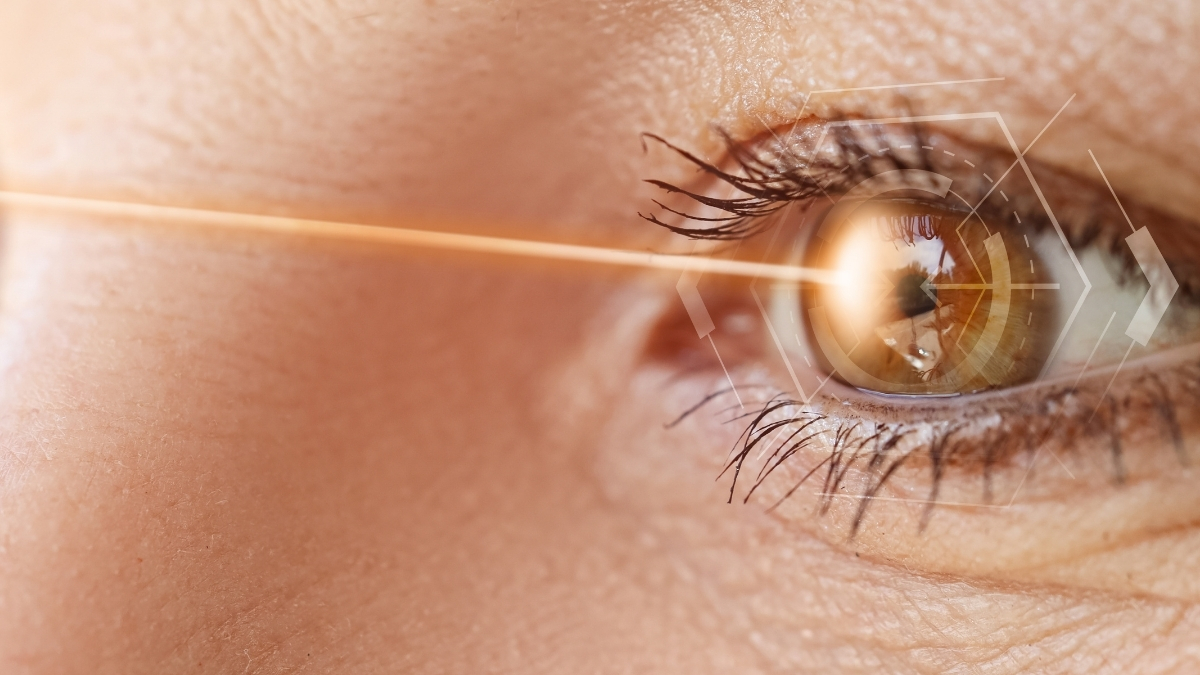
SMILE Laser (Small Incision Lenticule Extraction)
Minimal incision lenticule extraction method
SMILE is based on the principle of creating a thin lenticule within the cornea using a femtosecond laser and removing this tissue through a small tunnel incision. It is one of the modern laser methods that aims to preserve corneal biomechanics more by not opening a large flap. It is particularly preferred in patients with sufficient corneal thickness and moderate to high myopia.
Who is it Suitable For?
- Patients with moderate to high myopia
- Individuals with corneal thickness suitable for SMILE
- Cases without significant dry eye
- Patients seeking a laser method with smaller incisions
Structurally, it is not always an ideal option in low myopias due to the excessive thinness of the lenticule. Therefore, LASIK or surface ablation methods may be more predictable in small prescriptions.
Stages of the Procedure
1. Local anesthetic drops
The eye surface is numbed with drops.
2. Creation of the lenticule
The femtosecond laser creates a thin lenticule within the cornea and prepares a very small tunnel incision.
3. Removal of the lenticule
The lenticule is removed through the prepared small entry. A large flap is not created on the corneal surface.
4. Healing process
Mild stinging and tearing may occur in the first days. Vision gradually becomes clearer and full stability usually takes 1–2 weeks.
Advantages
- Minimal change in corneal biomechanics since a large flap is not created.
- It is a method with small incisions.
- Increase in dry eye may be less compared to LASIK.
- Return to daily life is rapid in most patients.
Limitations
- Visual recovery is not as fast as LASIK; full stability may take 1–2 weeks in most patients.
- The method may not be preferred in very low myopias due to the very thin lenticule.
- In astigmatism correction, LASIK may give more predictable results in some patients.
- It is not evaluated as a “superior method” for every patient; suitability depends on individual assessment.
General Assessment
Although SMILE is a modern and minimally invasive method, it may not be the most suitable option for every patient. A personalized choice should be made between SMILE, LASIK, or surface ablation methods based on factors such as corneal structure, refractive values, and dry eye.
SILK Laser (SILK = Smart Incision Lenticule Keratomileusis)
A different brand name from the same technology family as SMILE
SILK is technically based on the same principle as SMILE:
A lenticule is created within the cornea with a femtosecond laser and this lenticule is removed through a small incision. The difference between them is mostly the device brand, software used, and commercial naming.
- The basic mechanism of the method is the same as SMILE.
- No flap is created; the corneal surface is left as natural as possible.
- Although incision sizes and laser profiles may vary from device to device, it is essentially the same minimally invasive refractive surgery method.
CLEAR Laser (Corneal Lenticule Extraction for Advanced Refractive Correction)
- Next-generation variant of SMILE technology
- CLEAR is based on the principle of creating a lenticule within the cornea with a femtosecond laser and removing this lenticule through a small incision. It is essentially in the same technology family as SMILE; differences focus on the laser platform used, software optimizations, and lenticule creation algorithms. The aim is to create a more homogeneous lenticule and facilitate surgical manipulation.
SMILE, SILK, and CLEAR are lenticule surgeries and are almost the same applications clinically.