
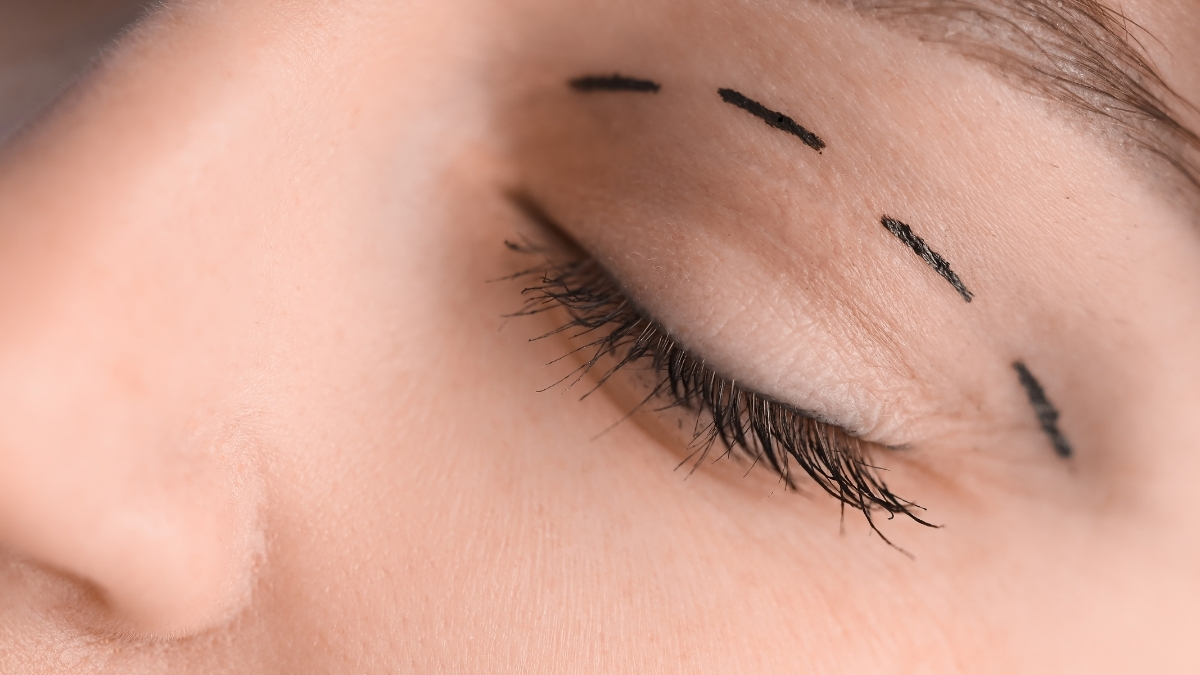
Brow Lift
Re-supporting the natural anatomical line of the brow and achieving a balanced form around the eye
Eyebrows can shift downward over time, becoming more prominent in the outer part. This both adds weight to the upper eyelid and can cause a tired or asymmetric facial expression. The aim of brow lift is not to artificially move the brow upward but to restore the drooped brow to its natural anatomical level.
Who is it Suitable For?
- Patients with significant drooping, especially in the outer part of the brow
- Individuals who find upper lid aesthetics alone insufficient
- Those with lateral or total brow drooping
- Individuals with asymmetry in brow–lid relationship
- Patients seeking a more balanced and rested appearance around the eye
In evaluation, brow–lid relationship, forehead muscle function, and skin elasticity are taken into account.
Surgical Techniques
A) Direct Brow Lift
A direct lifting procedure performed by removing a limited area from the skin immediately above the brow.
Who is it suitable for?
- Patients with significant lateral or total brow drooping
- Male patients (scar can be hidden in the natural line above the brow)
- Cases where brow skin elasticity is severely impaired
Advantage: Directly and controllably raises the brow in its own line.
Note: Patient selection requires care as a scar may remain on the skin.
B) Internal Brow Lift (Internal Browpexy)
This technique is applied through the same incision during upper eyelid aesthetics (blepharoplasty).
- The outer part of the brow is supported and fixed from inside.
- No additional external incision is made → scarless.
- The aim is not to excessively raise the brow but to fix the drooped brow to its anatomical place.
- Effective in preventing brow drooping after lid surgery.
It is a minimally invasive method that provides natural stabilization.
C) Temporal Lift
The most commonly used technique in patients with drooping in the outer 1/3 region of the brow.
- Tissues in the temporal region are released.
- The outer part of the brow is supported to its natural level.
- The temple region is tightened and pulled upward.
- Incisions are invisible as they are within the hair.
When combined with upper lid aesthetics, it gives quite balanced results.
D) Medial Brow Lift
Applied in more limited cases where the inner part of the brow has dropped.
The goal is to correct the imbalance in the inner half of the brow.
Recovery Process
- Swelling and mild bruising may be seen in the first 2–4 days.
- Sutures, if any, are removed in 5–7 days.
- Scar healing in direct brow lift requires more careful follow-up.
- Brow position may appear higher in the first days due to edema; it settles to its natural state within a few weeks.
Advantages
- Brow and upper lid relationship becomes more balanced.
- Lateral brow drooping is corrected naturally.
- Internal technique provides scarless support during lid aesthetics.
- When the correct technique is selected, understated and symmetric results are obtained.
Limitations
- There is a possibility of scarring in direct brow lift.
- Brow stability may vary from person to person.
- Careful planning is necessary as excessive lifting can create an unnatural expression.
- In patients with low skin elasticity, long-term stability may be limited in some techniques.